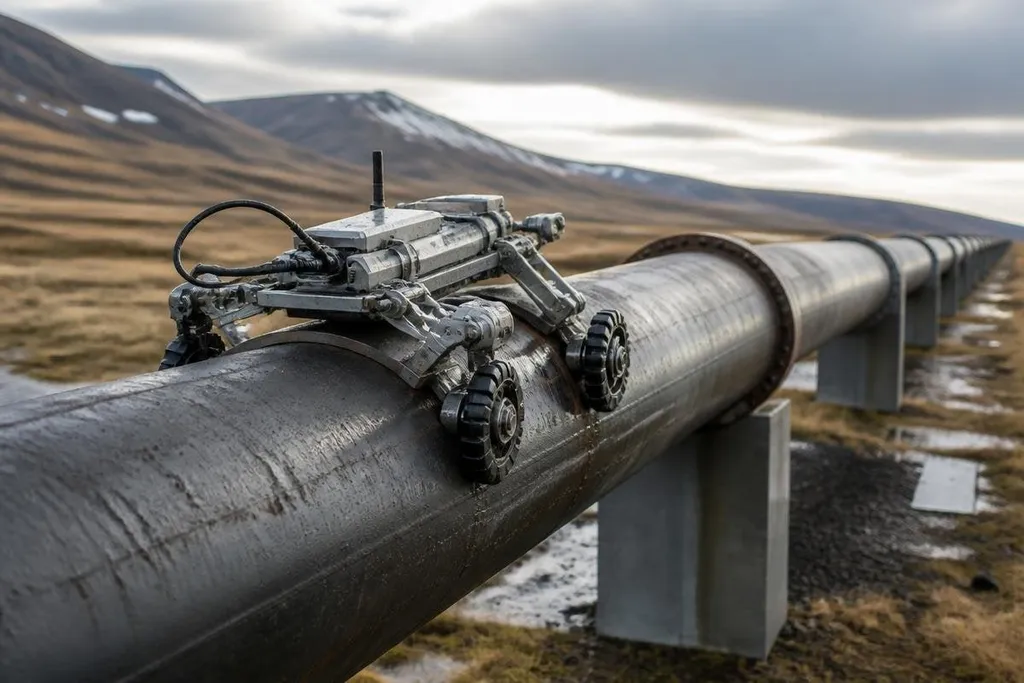
A pipeline robot has to inspect a long, dark, dirty route while carrying enough power to finish its task. That makes the global race hard to judge from a launch video or a list of new prototypes.
- Check the task first: internal inspection and outside inspection need different robots.
- Ask for measured results: distance, inspection accuracy, runtime, and recovery time matter.
- Treat field use as the test: a working pilot says more than a lab demonstration.
The robot has to fit the pipe
Pipeline robots do different jobs. An internal inspection system travels inside the pipe and checks the wall, welds, or shape. An external robot may move along the outside surface, carry a camera, or work near valves and support structures.
That difference changes almost every design choice. The robot needs the right wheel or leg layout for the pipe size, a way to handle bends, and sensors that can read the surface under dirt, water, or coatings.
A system built for a straight pipe may struggle when the route includes bends, changes in diameter, or blocked sections. The useful question is specific: what section of pipeline can this robot inspect without human contact?
A maker should state the pipe diameter range, travel distance, inspection speed, sensor type, and recovery method. Without those details, “pipeline robot” describes a category rather than a working product.
The numbers that decide field use
Operators need results they can plan around. Runtime tells them how much pipe one mission can cover. Travel speed shows how long a shutdown or inspection window may last. Sensor accuracy affects which findings need a second check.
A good test report should also state the conditions. Was the robot moving through a clean section or one with residue? Did it handle a bend? Was the data checked against a known defect? Did the robot return under its own power after a lost signal?
These details matter because inspection is only one part of the job. The data must reach an operator in a usable form, and the robot must leave the pipe without adding another recovery task. A shorter mission with a clear report may be more useful than a longer mission that leaves uncertain results.
A robot that moves through a pipe still has to inspect the right surface and return with usable data. Reports at Robot24 can connect the machine, pipe size, inspection task, test date, sensor, and measured result before the next section looks at where field work can slow the race.
Where the race can slow down
Pipeline work brings limits that a test floor may hide. A robot may need to run without a strong radio link, carry its own power, and keep its sensors working as the surface changes. Access can also decide the result: a system that needs a large launch point may fit one site and fail at another.
Maintenance matters too. Operators will ask how long a battery takes to charge, how sensors are cleaned, and which parts can be replaced on site. They will also need a clear record of what the robot saw, where it saw it, and how the finding was checked.
The strongest opposing view is that early prototypes still matter because they show which designs may work later. That is fair. A prototype can prove that a wheel system, sensor package, or control method deserves more testing, but it cannot prove safe service across a pipeline network.
A buying and testing checklist
Use these questions before treating a pipeline robot as ready for a serious trial:
- Define the route: record pipe size, bends, access points, surface condition, and expected distance.
- Set the result: name the defect types, location accuracy, report format, and review process you need.
- Request the test record: ask for mission length, speed, runtime, signal loss, and recovery results.
- Plan the human work: assign people to launch, monitor, review data, and recover the robot.
- Price the whole trial: include training, spare parts, charging, data review, and any shutdown time.
I’d judge the global race by repeatable field results, not by how many teams announce a prototype. The next useful milestone is a public test that names the pipe, the conditions, the distance, and the findings the robot produced.